More Than a Scenic Walk: The Ancient Story of Lake Rotoroa
Thursday 12 February 2026
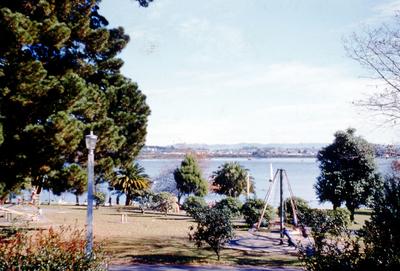
A man spraying at Hamilton Lake as part of the weed eradication experiment, March 1957. Reference: 2025.27.87
Long before it became a place for leisurely walks and weekend picnics, Lake Rotoroa was shaped by forces far older than the city that now surrounds it. Formed more than 20,000 years ago through natural geological processes, the lake has always been a place of life and movement. To Maaori it was known as Rotoroa, meaning Long Lake, and it sat at the heart of a rich and carefully managed landscape.
Drawn by fertile soils, abundant bird life and resource rich wetlands, many Waikato hapuu settled in the area known as Kirikiriroa. Ngaati Koura established Te Rapa Paa, while Ngaati Wairere settled at Kirikiriroa Paa and Whatanoa Paa. Well worn ara connected these paa to Lake Rotoroa, reflecting the lake’s importance as a source of food, water and materials essential for daily life.
The ridges around the lake were thick with fern, maanuka, harekeke and toetoe. Raupoo from the wetlands was used to build whare, while kareao and mangemange vines provided strong lashings and were woven into eel pots. The lake itself offered an abundance of freshwater foods including tuna, kooura and kaakahi. Nearby soils were carefully modified with sand and gravel to create puke for growing kumara, showing the depth of environmental knowledge held by tangata whenua.
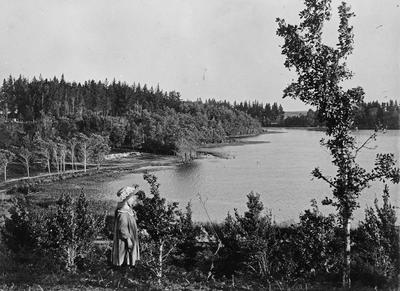
A young girl amongst the bushes admiring the southside of Lake Rotoroa. Reference: HCL_10684
Forests of kahikatea, tawa and hiinau thrived in areas now known as Gower Park and Innes Common. These trees supported birdlife such as kuukuu, tuuii, kaakaa, ducks and kiwi, all of which were harvested, preserved and stored as valued food sources. Along the swampy lakeside, an area known as Paretaru, stands of tall trees attracted kereruu in particular, adding to the seasonal food supply.
After 1864, the landscape around Lake Rotoroa began to change significantly as settlers cleared large areas for military training and recreation. Development was slower on the western side of the lake, where peat and swampy ground made access difficult. Over time, drainage, planting and landscaping altered the character of the area, and by the late nineteenth century the lake had become a popular recreational space. Community efforts such as tree planting days played a small part in shaping what became the Hamilton Lake Domain.
Today, as the lake continues to evolve, its deeper history remains embedded in the land. Beneath the paths and plantings lies a place that sustained generations of tangata whenua, a reminder that Lake Rotoroa has always been more than a scenic backdrop. It is a living landscape with origins that reach far beyond the arrival of Europeans, and its story continues to be shaped by those who care for it.