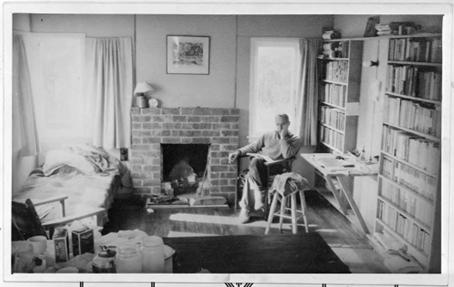
Queer Icon - Frank Sargeson
This is a part of a series for Pride Month, which profiles queer icons throughout Aotearoa history.
Frank was born as Norris Frank Davey in Hamilton on March 23, 1903. His father Edwin Davey was the town clerk for Hamilton, and along with his wife were stewards of the local Methodist congregation. Frank was schooled at Hamilton West and Hamilton High School, excelling in sports and debating, with promise in English and history. From 1921, he worked in a solicitor’s office by day and studies for his legal qualifications at night. 1925, Frank moved to Auckland to finish his studies to become a solicitor. 1927, he sold land in Hamilton and brought a ticket to England. There he explored galleries, museums, concert halls, and theatres. He went hiking through Devon, Cornwall and somerset, then off to France, Switzerland and Italy. He moved back to NZ in March of 1928, and worked in the Public Trust Office in Wellington, where he wrote poetry and stories by night. Our understanding of Frank’s sexuality is minimal, as it wasn’t something he ever outwardly discussed.
Frank Sargeson kept his sexuality heavily secretive and was not something that was openly shared, so much so that many only found out through Michael Kings novel Frank Sargeson: A Life which discusses Franks arrest. In 1929, he and his companion, Leonard Hollobon, were arrested for indecent assault, after they had slept together. Hollobon received five years imprisonment and Sargeson a suspended sentence. There has been little exploration into the dynamic of Sargeson dalliance with the law, but Michael Kings interpretation of the events paints a scandalous and volatile capturing of the two men in the act, as a result of a sting operation where Sargeson was situated as a victim in order to get Hollobon. Chris Brickell, however, in his book Mates and Lovers, debunks the sensationalised narrative. Brickell found Hollobon’s court file at National Archives which told a story in which Hollobon betrayed Sargeson. So it goes, Hollobon called Wellington Police to report that he was being blackmailed for five pounds. Two detectives show up to his doorstep to see why he would be getting blackmailed… he explained he had been indecently inferring with men; he named two Sailors and Sargeson. There had been no bursting in on the two, or any such activities. The entrapment approach was not a common arrest model for police to enact on gay men. The discovery by Brickell completely reshapes the common understanding of the gay liberation movement in Aotearoa. Kings’ narrative is a sensationalized narrative that engages in tantalizing the gay liberation movement.
Sargeson never outwardly spoke about being gay, or the possible jail time. Instead, he changed his name from Norris Davey to Frank Sargeson, became a literature icon and inspired many more to become authors.